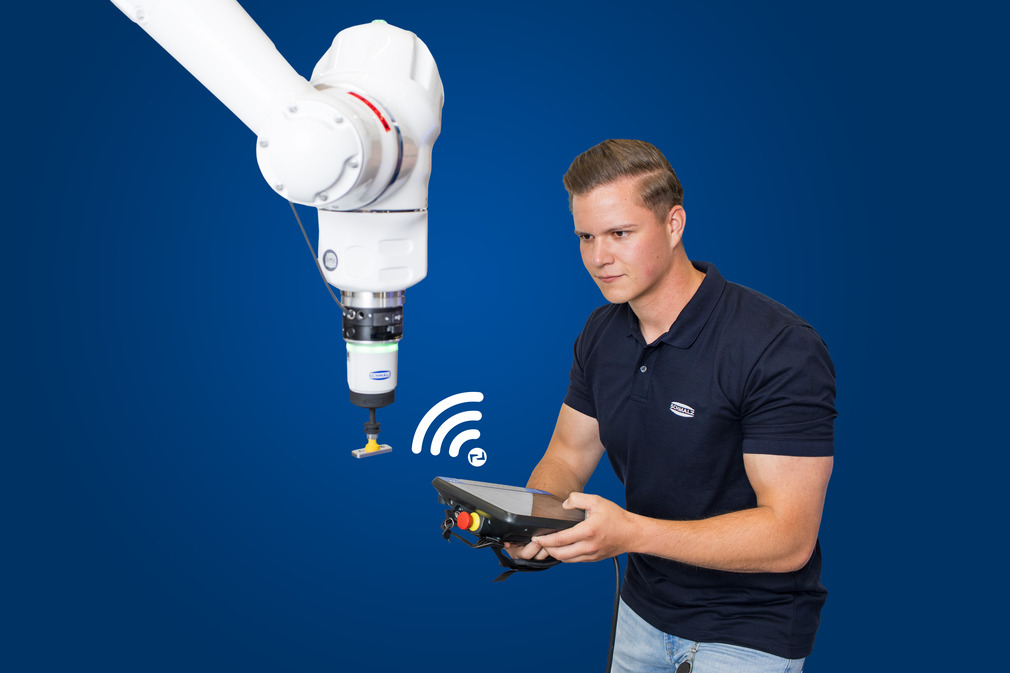
IO-Link
IO-Link is a communication system for connecting intelligent sensors and actuators to an automation system. It is used for bidirectional communication with all common fieldbus systems. This enables remote parameterization and remote diagnosis.
Frequently asked questions
What is IO-Link?
IO-Link is a point-to-point communication standard in automation technology. IO-Link enables continuous communication from the sensor/actuator level to the higher-level control system (PLC) and beyond to the control level. The intelligent field device uses this interface to transmit data about its status, energy consumption and the process. At the same time, parameters can be changed on the control system and transferred to the product.
How is an intelligent field device integrated into the system via IO-Link?
The intelligent field device is supplied with power via the IO-Link connector and integrated into the system. The device is connected to the IO-Link master via the IO-Link cable and integrated into the control system from there. This significantly reduces the amount of cabling required for a system. The parameterization of the devices is stored in the higher-level automation system. If a field device is replaced, the existing parameters can be transferred quickly via IO-Link.
The IO-Link master and the field device are connected via a maximum 20 m length of unshielded, 3-wire cable.
What is an IO-Link master?
A system can consist of several IO-Link devices. Each device is connected to the IO-Link master. The master is the interface to the higher-level control system and controls communication with the connected IO-Link master devices.
Where is the data stored?
The data can be stored in external or in-house clouds.
What is the difference between IO-Link and Ethernet?
IO-Link and Industrial Ethernet enable continuous communication from the sensor/actuator level to the higher-level control system (PLC) and beyond to the control level.
IO-Link is a point-to-point communication standard, while Ethernet is based on a bus system. When using Ethernet, several participants can communicate directly with each other. Unlike IO-Link, Ethernet does not require an additional IO-Link master.
What is the IODD?
IODD stands for IO Device Description. It contains information on the identification, process and device data of sensors and actuators with an IO-Link interface. The IODD consists of a main file and various image files.
Where can I find the IODD?
The IODD can be found for intelligent Schmalz Online Shop devices. First call up the desired part number or name. In the "Documentation" tab, you will find the IODD as well as the instruction manual.
What is a function block?
Schmalz offers function blocks for download for its intelligent devices to integrate the devices into different control systems quickly and without major manual adaptations. Function blocks for IO-Link devices simplify communication with the PLC by providing device and process parameters.
Where can I find function blocks?
You can find the function modules directly next to the corresponding product in the Online Shop. Call up the desired part number or name. In addition to the instruction manual, you will also find the function blocks in the "Documentation" tab.
What are field devices such as sensors and actuators?
Field devices are all devices that are installed directly on the machine or in the process environment and communicate with the control system. These include in particular
- Sensors: they record physical sizes such as temperature, pressure, position or fill level and supply the measured values to the control system. Examples at Schmalz are vacuum sensors or pressure sensors.
- Actuators: They convert control commands into physical actions, for example by switching, moving or controlling valves, motors or grippers. Examples at Schmalz are compact ejectors or needle grippers.
Compact ejectors combine both functions: They contain both sensors and actuators.
What is a control system (PLC)?
The control system is the central electronic system in automation technology that monitors and controls the operation of machines and systems. It processes inputs from field devices such as sensors, makes decisions based on them and forwards commands to actuators to achieve the desired process.
Important features of the control system:
- Input processing: acquisition of signals and measured values from sensors and other field devices.
- Logic and programming: Evaluation of input data according to defined control programs (e.g. PLC programs)
- Output signals: Control of actuators to realize mechanical or electrical processes
- Communication: networking with higher-level systems, operating panels or control systems
Typical control systems are programmable logic controllers (PLC), which are used in almost all industrial automation applications. They are the "brains" of the system and ensure safe, efficient and flexible operation.
What does the international standard EC 61131-9 stand for?
IEC 61131-9 is an international standard that describes point-to-point communication via IO-Link.
This part of the IEC 61131 series of standards defines the requirements, interfaces and protocols for the transmission of data between field devices (sensors, actuators) and controls. The aim is to ensure standardized, interoperable and reliable communication in industrial applications.
Important aspects of IEC 61131-9 are
- Definition of interfaces and protocols
- Real-time capable data transmission with low latency
- Safety and interference immunity in industrial environments
- Compatibility with existing IO-Link systems
By complying with IEC 61131-9, the IO-Link communication standard ensures that devices from different manufacturers work together seamlessly and meet the requirements of modern Industry 4.0 applications.
What is bidirectional communication?
Bidirectional communication refers to the exchange of data in both directions between two communication partners. This means that information can be both sent and received - and in both directions.
In the context of IO-Link Wireless, this means:
- The control system (e.g. PLC) sends commands or parameters to sensors and actuators.
- At the same time, the sensors and actuators transmit status information, measured values or diagnostic data back to the control system.
This two-way communication enables flexible control, simple parameterization and efficient fault diagnosis, making automation processes more transparent and reliable.
What is a radio protocol?
A radio protocol is a set of rules that controls wireless communication between devices via radio waves. It defines how data is sent, received and processed to ensure a reliable and interference-free connection.
Important features of a radio protocol are
- Data transmission: How information is transmitted in the form of radio signals (e.g. frequency, modulation)
- Data format: Design and structure of the transmitted data packets
- Error detection and correction: Mechanisms to ensure data integrity
- Access procedure: Rules on how multiple devices share the radio channel without interfering with each other
- Security functions: Measures such as encryption to protect data from unauthorized access
In conjunction with IO-Link Wireless, the wireless protocol ensures that sensors, actuators and controls can communicate with each other wirelessly, in real time and reliably - even in demanding industrial environments.
Is IO-Link a bus system or a fieldbus?
IO-Link is not a fieldbus, but a point-to-point interface that works via cable or wirelessly (IO-Link Wireless).
How safe is IO-Link Wireless?
IO-Link Wireless uses modern encryption and frequency hopping to ensure safe and interference-free communication.